
Clay County Parole vs Probation
Parole and probation can both require a person to report in the community, but they begin in different ways. A Clay County case that led to a state prison term may later involve a parole decision by the Georgia State Board of Pardons and Paroles. Felony probation comes from a court sentence. The Georgia Department of Community Supervision, or DCS, supervises both parolees and adult felony probationers in the field. The official county page identifies Sheriff Shivers, whose office remains the source for a separate local jail release.
| Point | Parole | Felony probation |
|---|---|---|
| How it begins | The Parole Board grants supervised release from a state prison sentence. | A court imposes probation as part of the sentence. |
| Decision record | Board inmate, TPM, and parole records | Court docket, sentencing order, or probation order |
| Field supervision | DCS supervises the parolee in the community. | DCS supervises adult felony probation under its jurisdiction. |
| Clay County route | Board search first, then DCS Donalsonville for local supervision routing | Clay County court record first, then DCS Donalsonville for local supervision routing |
A bond release is neither parole nor probation by itself. Someone may leave Clay County Jail on bond while the criminal case remains pending. The sheriff can address the custody event, and the court record can explain the bond or sentence. The broader Clay County released-inmate search path shows where to check a local jail release that does not involve supervision.
Verify Clay County Post-Release Supervision
The most reliable search sequence follows the source of the supervision order. There is no single Clay County page that combines jail release, parole, and felony probation. The Board search identifies state parole information. A court file identifies probation. DCS then provides the field-office route for either type when it falls within the agency's jurisdiction.
- Decide whether the person left Clay County Jail, left GDC custody, or received probation through a court sentence.
- For possible parole, use the Board's parolee search with first name, last name, and race when known.
- Review partial-name results with care because the search can return records containing the entered term.
- For possible felony probation, check the Clay County court docket and sentencing or probation order.
- Use the DCS Donalsonville Field Office to route a Clay County supervision question that the public record does not resolve.
- Ask the agency that owns the record for formal confirmation when the exact status or discharge date matters.
Note: Disappearance from a jail roster proves neither parole nor probation because a current-custody list does not serve as a supervision record.
Clay County Parole Search Channels
The Georgia State Board of Pardons and Paroles links to inmate lookup and parolee database functions. These tools serve different stages. A person who is still in GDC custody may have parole consideration or a Tentative Parole Month, known as a TPM. A person released on parole may appear in the parolee database. Neither result is a Clay County jail booking record.
A TPM is not a parole grant or a guaranteed release date. It is the month in which the Board expects to complete final review and, if appropriate, set a release date. Misconduct, a required program, a detainer, residence-plan concerns, or new information can postpone or cancel it. The Board also retains discretion to change a prior decision before release.
Most parole-eligible inmates are considered automatically, and the Board says most become statutorily eligible after one-third of the prison sentence. Eligibility only opens the decision process. It does not mean release will occur then. Serious violent felony restrictions under O.C.G.A. § 17-10-6.1 and other non-eligible categories can alter or eliminate the ordinary parole path.
Clay County DCS Office Details
Clay County's listed community-supervision office is outside Fort Gaines. DCS assigns the county to its Donalsonville Field Office, which also serves Early, Miller, the Pataula Circuit, Quitman, Randolph, Seminole, and Terrell. This is the practical local contact for parole and adult felony probation reporting questions under DCS supervision.
Georgia DCS, Donalsonville
223 S. Wiley Avenue
Donalsonville, GA 39845
Monday-Friday, 8:00 a.m.-4:30 p.m.
Phone: (229) 524-2836
Fax: (478) 216-2085
The official DCS page is the source for the office assignment and contact details. It can route questions about where a person reports or which office holds a community-supervision record. It is not a jail status line, a parole decision portal, or a release-date calculator.
The DCS Donalsonville listing shows the office that serves Clay County.
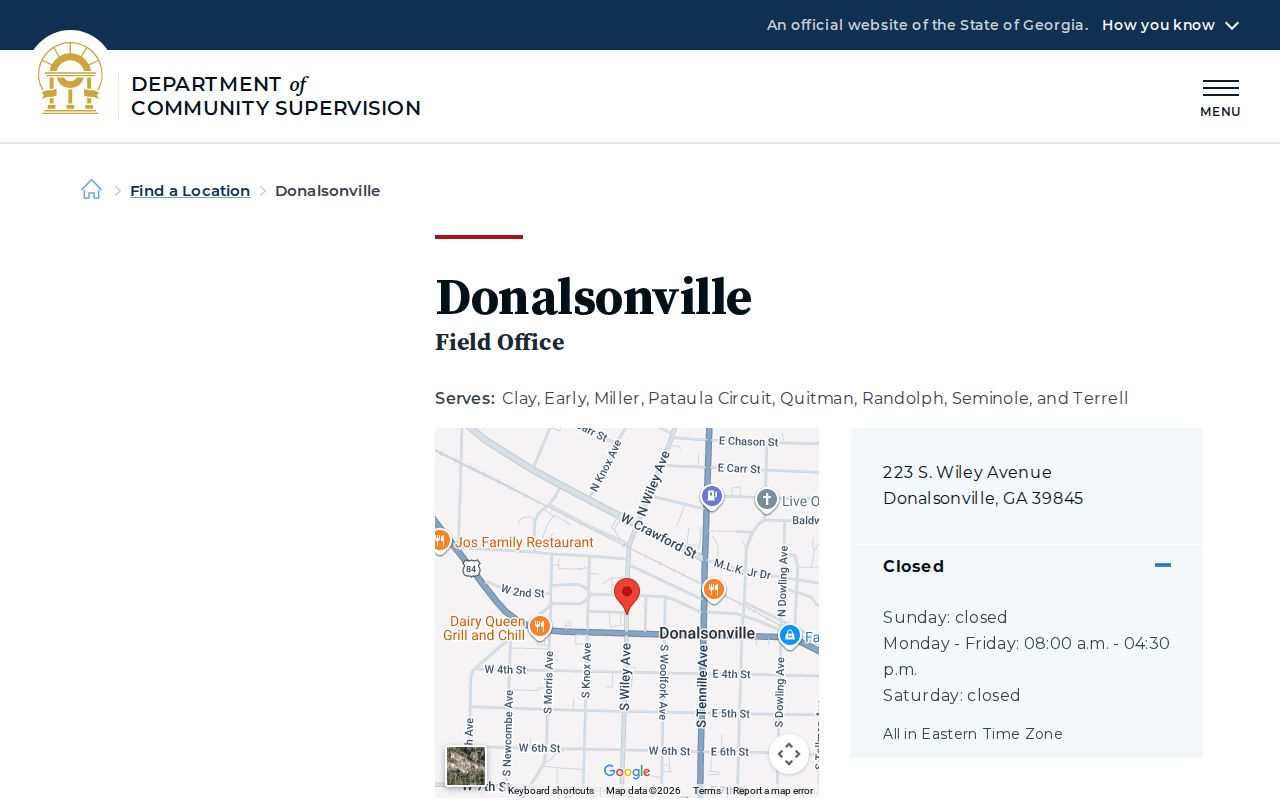
That service-area listing is the key local bridge between a statewide parole or probation record and the office that handles supervision in this region.
Clay County Supervision Runs Through Donalsonville
The local geography matters. A person released from Clay County Jail does not report to DCS merely because the jail stay ended. DCS becomes relevant only when parole or an adult felony probation sentence requires community supervision. When it does, the assigned office is Donalsonville rather than a Clay County counter in Fort Gaines.
This split helps prevent misdirected calls. Questions about booking, bond, release time, or transfer belong with the Clay County Sheriff's Office or the court that issued the order. Questions about parole reporting and felony probation supervision belong with DCS. Questions about whether parole was granted belong with the Board. The Pataula Circuit service area explains why a Clay County supervision record may be managed through a regional office serving several nearby counties.
Note: The Donalsonville assignment is a supervision route, not proof that every person released from the Clay County Jail has a DCS case.
Clay County Absconder and Warrant Checks
No Clay County-specific public absconder list was found in the reviewed official sources. That absence should not be read as a clean status. A person can be subject to supervision action or a warrant even when a simple public name search is unclear, and disappearance from the parolee search does not establish that supervision ended.
For a parole question, begin with the Board record and then seek agency confirmation. For felony probation, check the court docket for a revocation filing, warrant-related entry, or later order, then contact DCS when appropriate. For a local arrest warrant or jail status, contact the sheriff. Each office controls a different part of the record, so a broad question such as "is there a warrant" may need the case number and supervising agency to reach the right source.
Clay County Violations and Discharge Records
Supervision conditions come from the parole authority, court order, and DCS case. A reported violation does not by itself explain the final outcome. The responsible authority may investigate, impose a response within its authority, seek revocation, issue or request a warrant, or leave supervision in place. The court docket is central for a probation revocation case, while Board and DCS records are central for parole action.
Supervision ends through a formal discharge or expiration process, not merely because a person stops appearing on a familiar page. A parole discharge record belongs with the Board or the agency maintaining the parole record. A probation completion or termination should be traced to the court order and DCS record. If the person was only released on bond, there may be no supervision discharge at all because the underlying case may still be pending.
For an exact end date, ask for the document that establishes the result. Useful identifiers include full name, date of birth, court case number, GDC ID when applicable, and the known supervising office. Keep the response with the related court or agency record rather than treating a search-screen status as the sole proof.
Correct a Clay County Supervision Record
A disputed record should go back to the office that created it. The Clay County sheriff maintains booking, fingerprint, photograph, and local custody information. The Clay County clerk maintains court disposition and sentence entries. GDC owns state custody information, the Board owns parole-decision information, and DCS owns community-supervision records within its role.
This division matters when a bond-out is mistaken for parole or a state record is tied to the wrong local event. The sheriff cannot revise a Board parole field, and GDC is not the source for correcting a local bonding report. Identify the exact field, save the source page or document, and send the correction request to that record's custodian. A court order may be needed when the disputed item comes from a sentence or disposition.
Note: Record correction is fastest when the request names the field, source agency, case or offender number, and document that supports the change.
Clay County Parole Decisions vs Board Meetings
Public monthly Board meetings are not individual parole hearings. The Board publishes current agendas and notices through its press-release page. Its published meeting information says monthly meetings are generally operational public meetings and that offender cases are not discussed or considered there. Current notices control because dates can change or meetings can be canceled.
For one Clay County-related state inmate, use the inmate lookup, TPM lookup, GDC record, or direct agency confirmation. After parole release, use the parolee database and DCS route. This distinction keeps a public meeting calendar from being mistaken for a case-results list. Georgia does not provide a Clay County-specific public parole-hearing-results page in the research reviewed.