
Clay County Projected vs Actual Release
A projected date is a planning field based on facts known at the time. An actual release is the custody event after the jail or prison completes its checks. Those are not interchangeable. A Clay County expected date can move when a court changes the sentence, credit is corrected, earned time changes, misconduct affects a state calculation, a detainer remains active, or the Parole Board changes its decision.
A Clay County Jail detainee awaiting trial usually does not have a sentence-expiration date. The next event may be bond, a hearing, a court order, transfer, or case disposition. A sentenced county inmate can have a computed date. A GDC prisoner can have different fields for a release date, maximum release date, Tentative Parole Month, or later parole release date. The label controls the meaning.
Clay Earned Time vs State PIC
Clay County jail release dates and Georgia state-prison dates use distinct credit systems. O.C.G.A. § 42-4-7 authorizes the custodian of a county inmate to award earned time based on institutional behavior. The statute says a county inmate is released at sentence expiration less earned-time allowances. The Clay County jail or sheriff is the practical source for that local calculation.
Georgia's Performance Incentive Credit, or PIC, belongs to the state corrections system. GDC says an eligible state offender may earn up to twelve PIC points and potentially reduce a Tentative Parole Month or Maximum Release Date by one to twelve months. PIC does not apply to a local Clay County jail term simply because the county is in Georgia.
This distinction is the key local computation rule. Ask the jail about county earned time. Ask GDC about PIC and state release fields. Ask the Parole Board about a TPM or parole decision. Mixing those systems can produce an expected date that has no legal or administrative connection to the person's actual custody.
The Georgia county-inmate statute shows the earned-time rule used for county sentences.
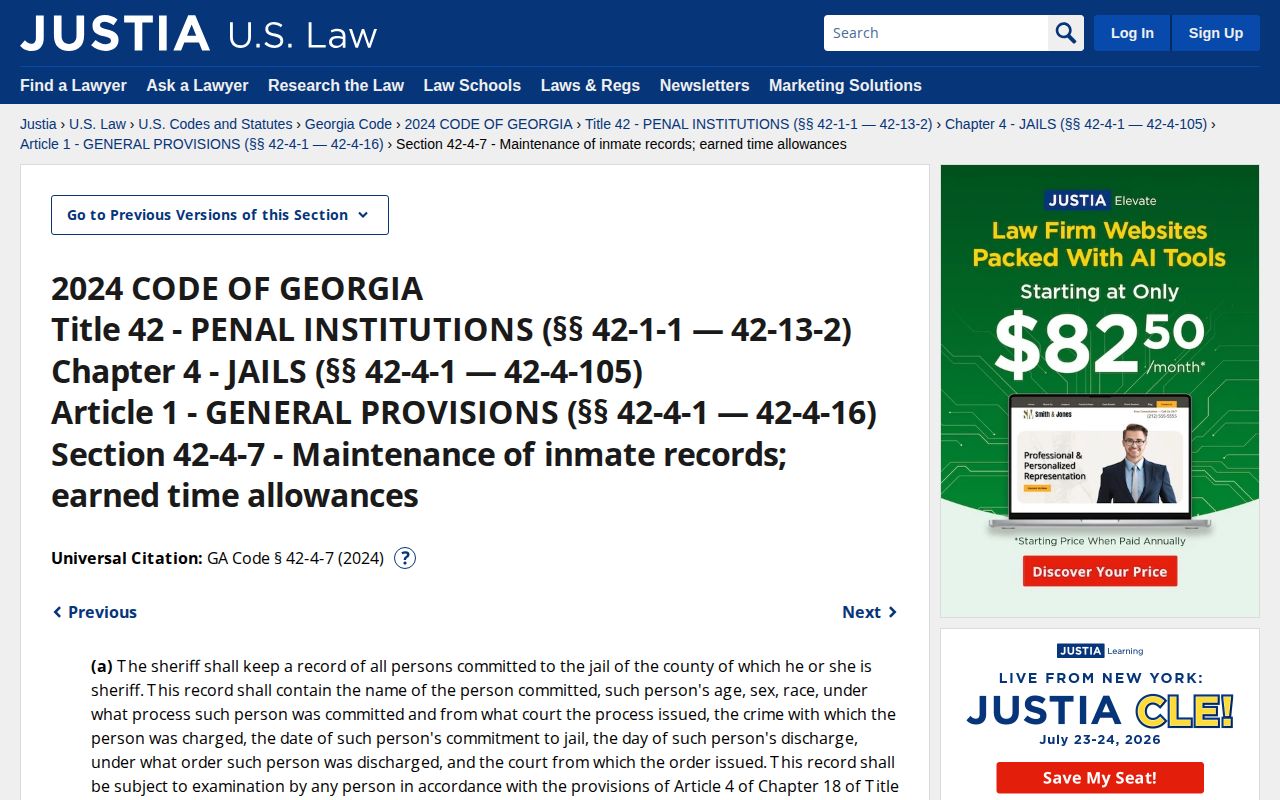
The statute places the allowance with the county custodian, which is why a local calculation must be confirmed with Clay County rather than inferred from a GDC program.
Find a Clay County Projected Release Date
The right workflow begins with custody type. Clay County has no public local roster or recent-release portal in the official sources reviewed, so a local date inquiry goes directly to the sheriff or jail. State-prison dates start with GDC and the Parole Board. A formal record is the final step when precision matters.
- Identify whether the person is in Clay County Jail, GDC custody, federal custody, immigration custody, or already released.
- For Clay County Jail, call the jail at (229) 768-2505 and ask whether the person is pretrial or sentenced.
- For a county sentence, ask for the release-date calculation, jail credit, earned-time status, bond or court status, and any hold or transfer.
- For state custody, use the GDC Offender Query, then compare any date with the Board's TPM information.
- Determine whether the field is a release date, Maximum Release Date, Tentative Parole Month, parole eligibility point, or final parole release date.
- Check whether a mandatory term, serious violent felony rule, life sentence, detainer, program condition, or other exclusion affects the expected date.
- Request official confirmation from the jail, GDC, Board, or court when the exact date is needed.
Note: A person who left Clay County Jail for GDC or another agency was transferred, not released to the community.
Clay County Jail Release Calculations
For a sentenced county inmate, the Clay County court supplies the sentence and may address credit for time already served. The custodian applies the county earned-time rule and carries out the release. A correction to jail credit, a later court order, or a change in earned time can alter the date. An active hold can prevent community release even after the local sentence calculation reaches its end.
The inquiry should be specific. Ask whether the person is being held on a Clay County sentence, a pending charge, a warrant, or another agency's request. Ask whether the date given assumes all current earned time. Ask whether there is a scheduled transfer. If the response is only "not in custody," follow up to determine whether the person went home, to GDC, to another county, or to another authority.
The Clay County Sheriff's Office page identifies Sheriff Shivers and states that the office prepares booking and bonding reports and furnishes inmate information on request. That direct-contact route is more relevant to a local jail date than the statewide offender search.
Clay County State-Prison Date Fields
Use GDC only when the person entered the state offender system. For a Clay County state case, the public tool can be searched by name, GDC ID, case number, age, and other identifiers. If the result shows a current GDC facility, leaving Clay County Jail did not mean release from state custody. If a date appears in the past, it can be a useful lead, but GDC directs users to verify public-search information with Inmate Records and Information.
| Field or result | What it means |
|---|---|
| Current facility | The person remains in GDC custody at the listed state location. |
| Release date | A state release-related date that should be read with its exact label and verified. |
| Maximum Release Date | The state sentence endpoint as calculated by GDC, subject to lawful changes. |
| Tentative Parole Month | The month for Board final review, not a promised release day. |
| No result | Not proof of release; the person may be outside GDC, entered differently, or not displayed. |
A public GDC result is a locator, not a certified discharge record. For written verification, GDC identifies Inmate Records and Information at PO Box 1529, Forsyth, GA 31029. Its open-records portal is another path when a releasable formal record is needed.
Clay County TPM and PIC Limits
The Parole Board calls its planning field a Tentative Parole Month. It marks the month for final review and possible setting of a parole release date. Misconduct can postpone or cancel a TPM. Program requirements, residence plans, detainers, and new case information can also affect the result. The Board may deny parole even when a person is eligible for consideration.
In a Clay County state case, PIC can affect the TPM or Maximum Release Date only for eligible state offenders. GDC excludes people under a death sentence, people with sentences of two years or less, non-parole-eligible or minimum-mandatory categories such as seven-deadly-sin offenders, and life sentences. The program therefore cannot be used as a blanket subtraction from every Georgia sentence.
The GDC PIC program page explains the state credit and its exclusions.
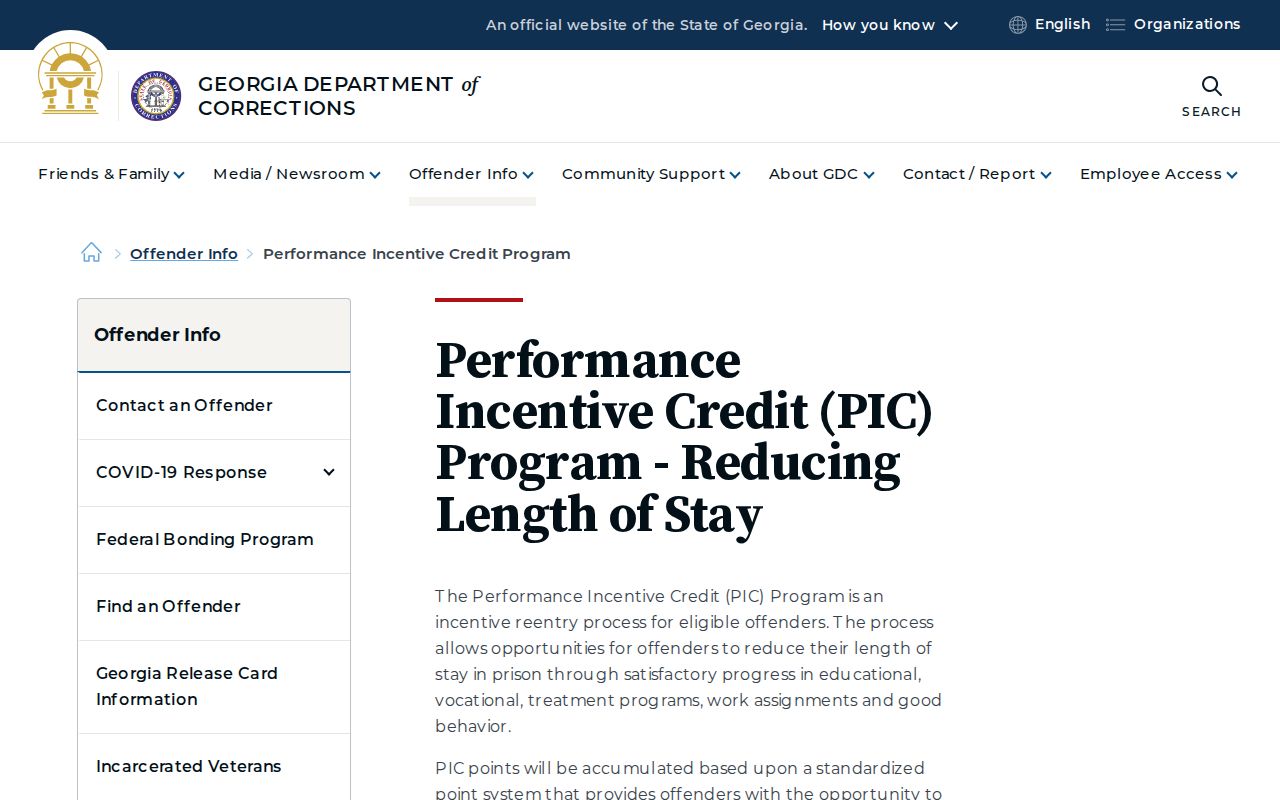
The program's own limits show why a Clay County case must be classified before anyone estimates a reduction in state custody.
Note: TPM is a Board planning month, while MRD is a GDC date field; neither term describes county-jail earned time.
Clay County Serious-Felony Release Limits
A Clay County release question cannot be answered with a flat eighty-five-percent rule for every state sentence. The Board says most parole-eligible inmates become eligible after one-third of the prison sentence, yet few are granted parole at the first eligibility point. Eligibility means the Board may consider release. It does not create a right to leave custody.
O.C.G.A. § 17-10-6.1 governs serious violent felony restrictions. Certain sentences must be served in their entirety without parole, early-release reductions, earned time, work release, or other sentence-reducing measures administered by GDC or the Board. The statute contains a limited final-year transitional-center or work-release provision. The offense, sentence, and offense date control, so a general percentage should never replace the case record.
Life-sentence parole eligibility also varies by offense date in the Board's materials. For certain serious violent felony life sentences, the cited milestones can be seven, fourteen, or thirty years depending on when the offense occurred. Those are points at which parole consideration may occur, not projected release dates. A Board grant may still include a program condition before release.
What Changes a Clay County Release Date
A release date can move for reasons found in the sentence, jail calculation, prison record, parole process, or next-custody system. The following table keeps those sources separate so that a change in one system is not misread as a rule in another.
| Factor | Possible effect | Source to verify |
|---|---|---|
| County earned time | An award or withheld allowance changes the local sentence-expiration calculation. | Clay County Jail or sheriff |
| Jail credit correction | A corrected credit changes time remaining on a county sentence. | Court order and jail calculation |
| PIC eligibility or points | Eligible state offenders may receive a change to TPM or MRD. | GDC |
| Institutional misconduct | A state TPM may be postponed or canceled. | GDC and Parole Board |
| Parole review | The Board may grant, deny, reconsider, or condition release. | Parole Board |
| Detainer or hold | The person may transfer to another authority rather than enter the community. | Holding agency and requesting authority |
| Court order | Sentence modification, bond, dismissal, or another order can change the custody basis. | Clay County court record |
Residence-plan review and required programming can also affect a parole timeline. A projected date should therefore be read with the most recent Board, GDC, court, and custody information rather than copied from an older screen.
Confirm a Clay County Release Date
Final Clay County release verification goes to the agency holding the person. For Clay County Jail, ask whether release processing is complete and whether any other hold changes the destination. For GDC, compare the offender record with TPM information and seek written confirmation when the date must be exact. For a court-driven release, obtain the order and confirm that the jail executed it.
Georgia VINE can provide a custody-change alert when the relevant agency participates, but it is not the permanent release record. The Clay County VINELink check guide explains how to register for one person's notifications. A missing VINE result does not establish release, and an alert does not explain every court or sentence detail.
If the date has already passed, ask for the completed release date and destination rather than the old projection. That last point distinguishes community release from transfer to GDC, another county, federal custody, or immigration custody. The actual custody trail is more useful than an estimate once the event has occurred.